-
Who This Checklist Is For
-
Step 1: Size Drives by Duty Cycle, Not Peak Torque
-
Step 2: Choose the Motor Architecture First
-
Step 3: Don't Ignore the Coupling—Especially Universal Joint Couplings
-
Step 4: Verify Part Numbers, Flanges, and Authorized Sources
-
Step 5: Perform a Receiving Inspection Before It Hits the Floor
-
Common Mistakes I See in Quality Reviews
-
The Bottom Line
Let's get one thing out of the way first: 2025 Boston Marathon gear and Boston Gear are not the same thing. One is carbon-plated running shoes. The other is gearboxes that keep production lines moving. I'm a quality manager at a motion control components manufacturer. I review 200+ shipments a year, and in our Q1 2024 audit, we rejected 4 out of 28 gearbox lots because the specified ratios didn't match the stamped nameplates.
I don't use the word "guaranteed" a lot. In power transmission, a guarantee comes from verifying the spec. The five-step checklist below is for anyone buying or receiving Boston Gear products in 2025—whether that's a stepper motor with encoder, a universal joint coupling, or a servo motor (yes, we'll answer "what's a servo motor" along the way).
Who This Checklist Is For
If you're an engineer, maintenance lead, or procurement person sourcing motion control parts, this is for you. It also matters if you're placing a small trial order. I've seen vendors treat a $300 order like it doesn't deserve the same engineering review as a $30,000 order. I don't think that's right, and I'm not shy about saying it.
Step 1: Size Drives by Duty Cycle, Not Peak Torque
The most common mistake I see is sizing a gearbox based on the motor's peak torque—then picking the smallest frame that fits the catalog. From the outside, it looks fine. The reality is that heat comes from continuous torque over the duty cycle, not the peak. If you ignore duty cycle, you've sized it right up until the day it overheats.
For any Boston Gear reducer or stepper motor drive, write down these numbers before you call a distributor:
- Continuous torque and RMS torque, not just stall torque
- Duty cycle: is it running 30% of the time or continuously?
- Ambient temperature and cooling path
- Radial or axial load on the output shaft
If you skip this step, you're buying by hope, not by specification.
Step 2: Choose the Motor Architecture First
People still ask us "what's a servo motor" all the time. Here's the version I use in quality reviews: a servo motor is a closed-loop device. It uses a feedback device—usually an encoder or resolver—and a matched drive to hold position or velocity. You choose a servo when you need fast acceleration, high dynamic response, or precise speed control.
But for many positioning jobs, a stepper motor with encoder is a smarter buy. A regular stepper is open-loop; it assumes the shaft moved the commanded steps. A stepper motor with encoder adds feedback so the drive can detect lost steps and correct them. It's not a servo, but it's a real upgrade for machines like pick-and-place stations where a missed step means a ruined cycle.
Price-wise—q4 2024, from memory—a NEMA 23 stepper with an encoder runs roughly $150 to $350 depending on the drive and cable length. Don't quote me to your purchasing department, but it's a reasonable ballpark.
Step 3: Don't Ignore the Coupling—Especially Universal Joint Couplings
Most field failures I investigate aren't in the motor. They're in the connection between motor and load. A universal joint coupling is invaluable when the shafts aren't perfectly aligned. It can handle angular misalignment that would wreck an elastic coupling.
But a universal joint has personality. It can produce output speed fluctuation even with steady input speed—especially at larger angles. That fluctuation can cause vibration, noise, and even encoder feedback errors on sensitive systems.
When reviewing universal joint couplings, check these specs:
- Maximum operating angle and your actual shaft misalignment
- Backlash or torsional lash, especially for positioning systems
- Torque capacity at your operating speed
- Whether locking elements match your shaft keys or set screws
I remember one batch in March 2023 where a vendor claimed their universal joints were "equivalent to Boston Gear." The material grade was visibly lower, and the pin bores were undersized. That single incident changed how I handle receiving inspections.
Step 4: Verify Part Numbers, Flanges, and Authorized Sources
If you're searching "boston gear charlotte nc" to find a local distributor, do yourself a favor: confirm the part numbers and mounting dimensions in writing. Boston Gear catalogs are structured around specific part numbers for a reason. A "compatible" part is not the same as a catalog-numbered part.
Check the obvious things:
- Shaft diameter: inch or metric?
- Flange standard: NEMA or IEC?
- Keyway dimensions and tolerances
- Input and output orientation
When I specify a Boston Gear product for our assembly line, I write "authorized distributor" and "catalog part number" directly on the PO. If a supplier can't confirm the exact part number, that's a red flag.
Step 5: Perform a Receiving Inspection Before It Hits the Floor
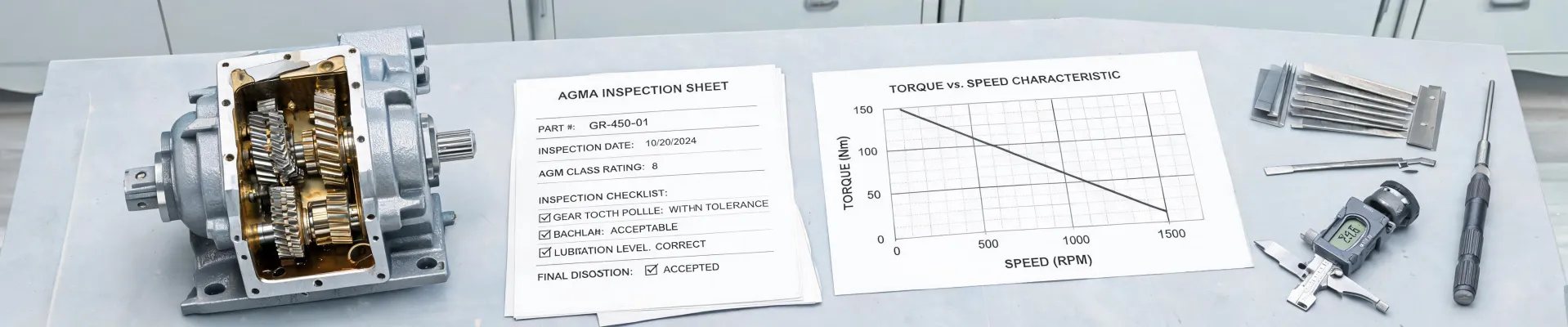
You don't need a full dynamometer to catch most problems. A simple receiving check catches a surprising number of issues. In the Q1 2024 audit I mentioned earlier, 3 of those 4 rejected lots had correct paperwork but wrong physical dimensions.
- Inspect packaging for damage, leaks, or signs of rough transport.
- Measure shaft diameter, keyway, and flange dimensions against the drawing.
- Rotate the shaft by hand. Feel for tight spots, grinding, or unusual resistance.
- If it's a stepper motor with encoder, energize it and confirm the encoder outputs clean A/B signals over the full travel range.
- Verify the nameplate and part number match the PO and catalog.
- Collect test certificates, coating certificates, or compliance documents before you sign off.
For small orders, do the same. I've had vendors try to skip calibration or metrology on low-value orders. I don't accept that. A $350 motor gets the same verification as a $3,500 one.
Common Mistakes I See in Quality Reviews
These are repetitive, and they're all avoidable.
Ignoring keyway tolerance. A sloppy keyway fit causes backlash and fretting corrosion. It doesn't show up in a visual inspection, so take the measurement.
Forgetting encoder cable shielding. A stepper motor with encoder is only as good as the signal integrity. Unscreened cables cause position drift and false faults.
Confusing step and servo assignments. Don't buy a stepper motor with encoder when the application needs true servo response. The encoder helps, but it doesn't turn a stepper into a servomotor.
Oversizing a universal joint coupling. Bigger isn't always better. Larger universal joints have more inertia and require more space. You want the joint that fits the torque and angle, not the one that maximizes the flange size.
Searching for "2025 boston marathon gear" while trying to buy gearboxes. That's a weird SEO collision, and if you somehow ended up here looking for running sneakers, well, I hope you find them. But if you're after motion control parts, this checklist is your starting line.
The Bottom Line
Small orders deserve proper specifications, proper documentation, and proper inspection. I've been on both sides of that table. When I was starting out, the vendors who treated my small purchases seriously are the ones I still trust with larger projects today.
You don't need to make every decision perfect. But you do need to check the five things that matter—duty cycle, motor architecture, coupling, sourcing, and receiving inspection. That's how quality actually happens.

Elena Markovic
Elena Markovic is an independent industrial motor and drive systems analyst covering induction motors, servo motors, stepper motors, and variable-frequency drives. She examines IEC 60034-30-1 efficiency classes, IEC 61800-9-2 drive-system losses, speed-torque curves, duty cycles, thermal limits, and feedback compatibility across operating envelopes. Her evidence-led guides help OEM engineers and plant teams select efficient motion packages, plan integration, and reduce commissioning risk.