I've spent the last seven years as a procurement manager at a 140-person automation company in the Northeast. I oversee roughly $1.6 million in annual MRO and motion-control spending—servo motors, gearboxes, bearings, you name it. I'm not an MIT-trained supply chain expert. In fact, a good friend of mine from UMass Boston is the one who first made me question how often we treat a supplier's lead time as a promise.
Here's my belief after more than a few painful lessons: when a motor or gearbox failure stops production, the certainty of a delivery date is worth more than the price on the purchase order. That's not a preference for fast shipping. It's about a vendor's commitment to a date—written down, backed by a consequence. That kind of certainty has a price. In my experience, it's almost always worth paying.
By the way, if you're new to motion control and wondering what's a servo motor?—it's a motor that gives precise control of position, speed, and torque, usually with an encoder for feedback. Most modern ones are brushless motors, so they don't have brushes to wear out. But they still have bearings, windings, and electronics that can fail. And when one fails on a production line, every extra day of repair becomes a line item on your P&L.
The $500 Decision That Changed My Mind
Take a FANUC servo motor failure we had in March 2024. One of our CNC machines stopped mid-cycle on a Tuesday morning. The motor was toast. We got two repair quotes:
The first, from a regional motor shop, was $2,450 with a '3 to 5 business day' turnaround. The second, from an authorized FANUC repair center, was $2,950 and guaranteed shipment on day eight—if it left later, the repair would be free.
My automatic reaction was to pick the $2,450 option. I even signed the PO. But when I called the regional shop to confirm the schedule, the owner said, 'It'll be between three and five days unless we get backed up.' I asked what 'backed up' meant. He said, 'It's usually fine.' That's not a commitment. I cancelled the PO and went with the authorized center.
The $500 difference seemed like a lot at the time. But here's what happened: the regional shop's motor actually took nine business days to come back, because they had to source a special encoder. The authorized center shipped on day eight exactly as promised. If we had stuck with the cheaper quote, we'd have lost an extra production day—at a cost of roughly $1,700 in margin. The $500 premium saved us $1,700 plus the late-night panic calls. That's when I started looking at every repair through the lens of 'what's the cost of a missed date?'
Lead Times Are Not Commitments
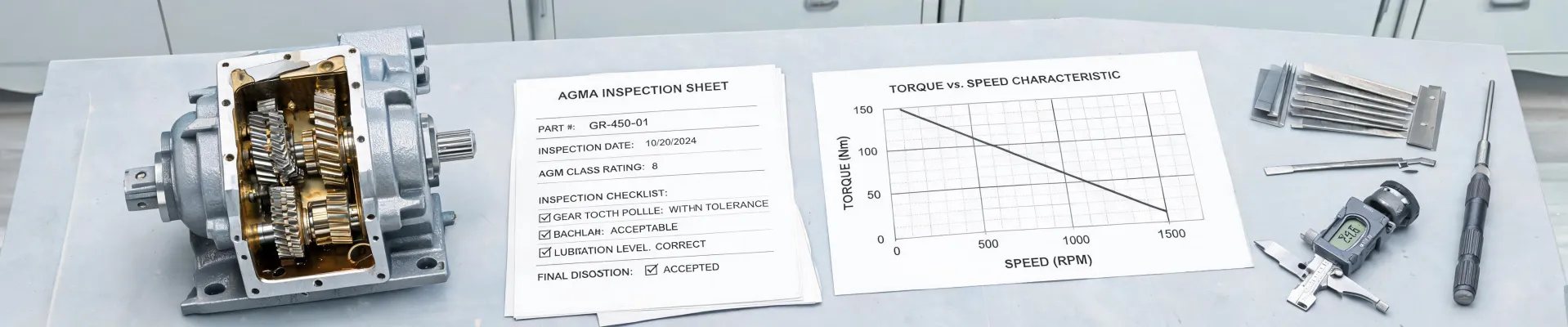
This issue doesn't just affect repairs. It applies to components you order every day, like Boston Gear 700 series parts. We use a lot of Boston Gear 700 series worm speed reducers on our conveyor drives. The 700 series catalog—which you can still download as a PDF from their website—lists AGMA service factor ratings for every unit. It's a solid reference for specs. But even a perfectly sized reducer won't help you if it arrives three weeks late.
Last year, we ordered a reducer from a distributor who quoted '2 to 3 weeks.' I want to say it was a 10:1 model, but don't quote me on the exact ratio. Two weeks passed. Three weeks passed. At the beginning of week four, we got an email that said a casting delay pushed it to week five. We ended up fabricating a temporary mounting bracket to keep a line running. That workaround cost $1,400 in machine shop time—more than the $750 reducer.
Here's something vendors don't generally advertise: 'standard lead time' is usually padded with buffer. It's not malicious. Manufacturers and distributors build in slack so they can batch production, absorb upstream hiccups, and keep their own machines full. But when they quote '2-3 weeks,' it's a projection, not a promise. And when you ask 'will it be here by the 15th?' the honest answer is often 'probably.' In a plant environment, 'probably' is a very expensive word.
The Counterintuitive Math of Certainty
Here's the logic that feels backward until you've lived through it: paying a premium for delivery certainty can lower your total cost.
Imagine you need a speed reducer. Quote A is $900 with a 4-6 week lead time. Quote B is $1,100 with a guaranteed 10-day arrival. Which is cheaper? If Quote A slips from five weeks to seven, and your line is down, those 15 extra days at $1,200 per day in lost margin come to $18,000. The $200 difference isn't gonna make or break your quarter—but a three-week delay might.
And even if Quote A doesn't slip, you're still left with uncertainty. You can't tell your own customers when your product will ship. You can't schedule your assembly team. You're stuck waiting to see. That uncertainty has a real cost, even if it never shows up on an invoice. I've built a simple cost calculator for this—after getting burned on hidden delays twice—and now our procurement team evaluates every critical purchase with line down cost per day.
The 'But It's More Expensive' Objection
I can hear the pushback. 'You're cost controller. You're supposed to fight for lower prices.' Yes, but total cost isn't the same as unit price.
We don't pay for guaranteed delivery on everything. Roughly 70%—maybe 75%, I'd need to check the dashboard—of our orders are standard stock items that can wait a week without hurting anyone. For those, we use the cheapest reliable supplier. But for the critical 20-30%—a FANUC servo motor repair, a Boston Gear 700 series replacement, any component that's already past due—we now budget explicitly for delivery certainty. That budget line exists because we got burned twice. It's not a luxury; it's a category.
'Why not just stock more spares?' is another fair question. It sounds good in theory. But a $3,000 servo motor sitting on a shelf is $3,000 of working capital doing nothing. We can't afford to stock every frame size, every ratio, every control board. We carry spares for the top five failure items, but the long tail of replacement parts depends on suppliers. And for that long tail, a delivery guarantee is worth more than a slight price cut.
The Bottom Line
Whether you're a plant manager in Ohio, a maintenance person in Texas, or an engineer at a lab that ends up searching for 'umass boston gear'—the underlying need is the same: a failed component has to be replaced by a specific deadline. The question to ask every vendor isn't just 'how much?' It's also 'when, exactly, and what happens if it's late?'
If a vendor won't commit to a date, they're selling hope, not certainty. And hope is a bad material to build a production schedule on. We still choose the low-cost option for routine orders. But for the purchases that can make or break a week, I'll gladly pay a premium for a guaranteed date. In the long run, it's the cheapest insurance our operation has.

Elena Markovic
Elena Markovic is an independent industrial motor and drive systems analyst covering induction motors, servo motors, stepper motors, and variable-frequency drives. She examines IEC 60034-30-1 efficiency classes, IEC 61800-9-2 drive-system losses, speed-torque curves, duty cycles, thermal limits, and feedback compatibility across operating envelopes. Her evidence-led guides help OEM engineers and plant teams select efficient motion packages, plan integration, and reduce commissioning risk.