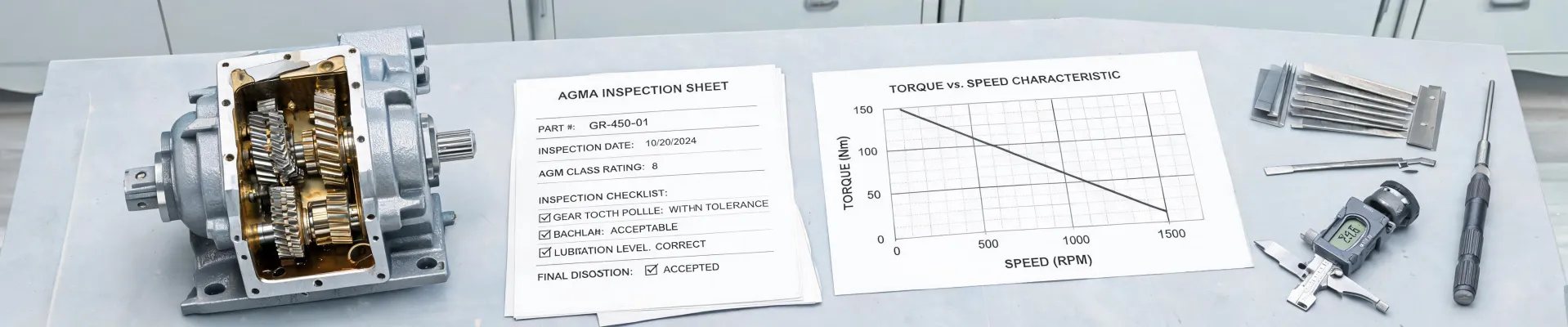
At 2:14 on a Tuesday, my phone rang. The transfer line was down. A gearbox on station four had stopped turning—no alarms, no smoke, just a grinding after the 2:00 shift break. The maintenance lead said "gearbox is shot." My first thought wasn't "replace it." It was "why?"
That "why" is what separates a $500 repair from a $9,400 problem. Over six years of tracking every invoice and every hour of downtime in our cost system, I've learned that the failed part is usually the messenger. The actual problem is hiding somewhere else in the system.
The Part You See Fails First
The components that fail fastest tend to be the ones doing the least glamorous work. Gear racks, pinions, cylindrical roller bearings, timing belt pulley flanges—these aren't the things people put on a wall plaque. They're the workhorses. And when they fail, the easy instinct is to blame the part.
I've had procurement colleagues order three replacement timing belt pulley flanges in one quarter before asking why the belt kept walking off the drive. I've seen a "failed" bearing replaced twice before someone checked the shaft hardness. And yes—if your search history includes "baby gear boston" because you're trying to identify the little pinion that chirps at 3 a.m., I know exactly how that feels. That tiny gear isn't the disease. It's the first part to report it.
Here's the uncomfortable truth: the cost of replacing components is rarely the point. A single Boston Gear rack or cylindrical roller bearing might be a few hundred dollars. The real price shows up in production records, not the invoice.
What's Actually Happening Under the Load
Let's go deeper. If a component fails prematurely, I look at four things before I approve a replacement. All four are cheaper to understand than a second failure.
Alignment and stiffness
Gear racks don't fail because they're weak. They fail because the pinion's pressure angle is loaded unevenly. The same is true for cylindrical roller bearings when the bore or housing is misaligned. These components are designed for tight geometric tolerances. When the frame flexes, or the base was shimmed incorrectly during installation, the actual load spikes far above the part's rating.
One of our machines went through two pinions before we measured the drive base with a dial indicator. It sat 0.014" out of parallel. A full alignment cost $1,100 and a day of labor—but it also ended the repeat failures.
The VFD effect
If you've ever searched for how VFD control motor speed, you know the simple answer: frequency changes, speed changes, voltage follows. But that's only the beginning. A VFD controls starting ramp, torque limit, and carrier frequency—and those settings change how the gearbox sees stress.
I remember a machine where the gearbox failed every time the operator hit "fast resume." The drive was set to six-second acceleration for normal stops, but the "resume" button was configured for 1.2 seconds. That abrupt torque spike twisted the output shaft—not because the reducer was undersized, but because the VFD was allowed to ignore it. We changed one parameter and the failures stopped.
The lesson: before you blame a gear rack or bearing, ask how the motor is being started and stopped. A misapplied VFD can turn a perfectly good driveline into a consumable.
Thermal and lubrication reality
Cylindrical roller bearings fail fast when the lubrication film breaks down. That can be oil level, oil type, or heat from something else. I've seen a gearbox "overheat" because an exchanger was blocked with paint overspray. The bearing was specified correctly—but the environment was never considered.
Thermal failure also catches people on duty cycles. A gearbox rated for continuous service might be fine. The same gearbox run through frequent cycles—start-stop-start-stop—generates more heat than the rating table assumes. At 3 cycles per minute, the oil never cools. This is exactly how a "too small" gearbox eats its own timing belt pulley flanges and bearings.
The Cheap Part Is Rarely Cheap
I know—this is the part where I'm supposed to say premium brands are always worth it. Let me be honest: I've tested cheaper parts. In my TCO spreadsheet, the savings don't last.
We compared three supplier quotes for a Boston Gear rack assembly two years ago. The low bid was 18% below the next one. But the quote didn't include technical application review, a critical lead time, or the possibility that the tooth profile wouldn't match our existing pinion. The order sample didn't match the drawing. Rework cost more than the discount. The "cheap" option was the expensive one.
The Real Price of Surface-Level Fixes
When the line is down, the math changes. Let me give you a real cost structure from Q2 2024 at our shop.
A failed bearing on a motorized roller unit stopped a packaging line for 14 hours. The replacement bearing kit was $340. The overnight expedite was $260. Total parts and shipping: $600. But the line's lost margin during that window was $9,400. So the expedite fee wasn't a luxury—it was the best $260 we spent that quarter.
Uncertain cheap is more expensive than certain expensive. When a deadline depends on a part arriving, the "maybe on time" quote is a liability.
I have mixed feelings about rush service premiums. On one hand, they feel like gouging at the moment you're most vulnerable. On the other, I've seen the operational chaos that downtime causes—overtime, missed shipments, expedited freight for the customer's order, and a maintenance crew working until 3 a.m. The premium is the price of knowing the part will be there. In an urgent situation, I'll pay for that knowing every time.
This is why our procurement policy now requires a documented delivery commitment for any component tied to a production schedule. If the supplier can't promise a specific date, they don't get the PO. That's not stubbornness. It's math.
The same logic applies to vendor selection. In March 2024, we paid a premium to get a replacement gearbox delivered in two days instead of a cheaper supplier's "about a week." The premium was $400. The cost of missing a $15,000 customer delivery window would have been—well, more than $400.
When I compared our parts spending and our downtime hours over a full year—same machines, different failure modes—I finally understood why the component price was almost irrelevant. A $200 bearing can stop a line that makes $700 an hour. The cost of the part is not the cost of the failure.
Get to the Root Before You Order
Here's what I tell every manager who asks whether they should order a replacement part or dig deeper: do both, but in the right order.
- Document the failure mode. Is it wear, fracture, overheating, or contamination?
- Check the adjacent system. Shaft alignment, base flatness, VFD starting parameters, and lubrication.
- Then order the replacement—ideally with application engineering help from a supplier who asks about the load profile, not just the part number.
That's why I value a supplier like Boston Gear. Our maintenance team keeps the boston-gear catalog PDF bookmarked on every tablet—it covers the obvious parts, from spur and worm gears to gear reducers, servo and stepper motors, cylindrical roller bearings, and timing belt pulley flanges. But the useful part is the support. When I send them a photo and a load profile, I get an answer that includes the why, not just the what.
If you're sizing a new Boston Gear rack system or replacing one, ask for the application review. If a bearing failed, ask for the system's operating temperature and alignment data. If a small gear keeps failing—the "baby gear" of the system—step back. It's telling you something.
One more thing about verification: don't accept vague claims. Per FTC guidance (ftc.gov/business-guidance/advertising-marketing), performance claims need substantiation. A supplier who says "this will solve your problem" without asking a single question is a supplier who hasn't found your root cause. A trustworthy supplier gives you load ratings, RPM limits, and temperature bounds—and sometimes tells you that you don't need the expensive part at all.
There's something satisfying about finding a root cause and fixing it permanently. After all the stress of a failed line, finally seeing it run smooth is the payoff. To get there, don't order the "baby gear" replacement on reflex. Look at the whole system, calculate the real cost, and then buy with certainty.
As of January 2025, our TCO spreadsheet still shows the same pattern: every avoided second failure was worth more than the so-called savings from the cheaper part. The numbers don't lie—they just need someone to read them.

Elena Markovic
Elena Markovic is an independent industrial motor and drive systems analyst covering induction motors, servo motors, stepper motors, and variable-frequency drives. She examines IEC 60034-30-1 efficiency classes, IEC 61800-9-2 drive-system losses, speed-torque curves, duty cycles, thermal limits, and feedback compatibility across operating envelopes. Her evidence-led guides help OEM engineers and plant teams select efficient motion packages, plan integration, and reduce commissioning risk.