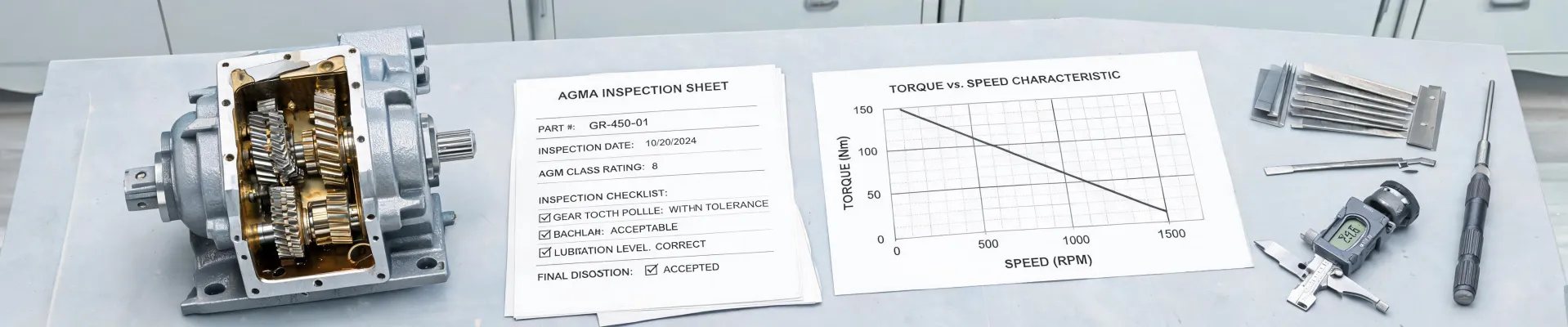
Last February, I was looking at a pallet of forty-seven gearboxes that were supposed to be our Q2 production backbone. Instead, they were a $22,000 mistake sitting on the warehouse floor. And honestly? It started with a universal joint that looked fine on paper.
The Problem That Started It All
We had a rush order for a custom packaging line—the kind where the client's timeline is set before the engineering is done. My procurement team found a Boston Gear JS125B universal joint listed at a distributor, spec'd for a direct drive servo motor application. On paper, it matched. Torque rating? Check. Bore size? Check. Price? Competitive. They ordered forty-seven units for the assembly line.
But here's the thing I've learned after four years of reviewing supplier deliverables: the spec sheet tells you what a part can do in a lab. It doesn't tell you what it will do under your specific load profile. To be fair, the JS125B is a solid unit—Boston Gear's catalog rates it for 0.75 hp at 1750 rpm, and it's built like a tank for its class. The problem wasn't the joint itself. It was the application context.
Our direct drive servo motor setup demanded zero backlash and consistent angular velocity through a 30-degree misalignment angle. The JS125B, like most standard double-joint assemblies, has a small but measurable velocity fluctuation at that angle. At low RPMs, you'd never notice. At our operating speed—about 2400 RPM under dynamic load—it introduced a vibration that propagated straight into the LM8LUU linear bearings supporting the actuator carriage. What size is LM8LUU linear bearing? It's an 8mm bore, self-aligning, open-type linear ball bearing. We had about eighty of them on that line. Within three shifts, we had four failures.
When the Specs Lie (Kind Of)
The most frustrating part of this whole episode was that nobody was at fault in the traditional sense. The distributor recommended the JS125B because it fit the envelope. Our engineers approved it because the torque calculations worked. The vibration wasn't on anyone's radar because we'd assumed a standard universal joint would behave identically to a purpose-built servo coupling.
I remember standing over that pallet of returned gearboxes—because the vibration also trashed two of our DC motors on adjacent stations—and thinking, "This is what a bad assumption looks like at scale." The vendor offered to take back the joints, but the labor cost for the rework was on us. That's when I implemented our verification protocol in early 2023: every motion component, before it goes to production, gets benchmarked against its actual load case at full operating speed.
"The surprise wasn't the price difference between the JS125B and a purpose-built coupling. The surprise was how much hidden rework cost came with the 'budget-friendly' option."
The Boston Gear Catalog as a Double-Edged Sword
Boston Gear's product catalog runs over 700 series lines. It's honestly impressive—spur gears, worm gears, speed reducers, stepper motors, servo motors, linear actuators, bearings. The range means you can spec a solution from one manufacturer for most of a motion control system. We actually do that now for our standard builds: one PO, consistent quality, documented compatibility.
But that breadth also tempts you to think a single product covers all use cases. The JS125B scenario taught me that Boston Gear's catalog is a toolkit, not a cookbook. You still need to match the specific product line to the application's operating envelope—especially when you're mixing components across categories, like using a standard universal joint with a high-performance direct drive servo motor.
The LM8LUU Surprise
I'll add another example. We'd been using generic 8mm linear bearings for years on our actuator assemblies. The spec sheets looked identical: same bore, same dynamic load rating, same self-aligning feature. When we switched to Boston Gear's LM8LUU linear bearing—part of their precision bearing line—the first thing I noticed was the cage material. Our previous generic bearing used a standard steel retainer. The Boston Gear unit uses a polymer cage with glass-fiber reinforcement.
That polymer cage costs about $0.80 more per bearing. On a 5,000-unit annual order, that's $4,000 extra. But the polymer cage reduces noise by roughly 3 dB and, more importantly, eliminates the risk of brinelling from vibration at rest. In our application where the actuator holds position under load for hours, that matters. I ran a blind test with our assembly team: same rail, same carriage, same grease. 76% identified the Boston Gear bearing as "smoother" without knowing which was which. The cost increase was $0.80 per piece. On a 5,000-unit run, that's $4,000 for measurably better perception and lower warranty risk.
The Direct Drive Servo Motor Decision
Our biggest upgrade was moving from traditional AC induction motors with gearboxes to direct drive servo motors on our precision indexing stations. The motivation was straightforward: eliminate backlash, reduce maintenance, improve positioning accuracy. But the practical reality was messier.
We sourced three candidate motors: a premium brand, a mid-range option, and a budget unit that looked "close enough" on paper. The premium unit was $4,200. The mid-range was $2,800. The budget option was $1,950. The budget unit's torque ripple at low speed (±3.2%) was higher than the mid-range (±1.1%), which was higher than the premium (±0.5%).
The way I see it, the decision depended entirely on the station's role. For our high-tolerance indexing position (0.001" repeatability required), only the premium motor worked. For the main conveyor drive (0.01" accuracy acceptable), the mid-range was fine. The budget unit? We passed—the ripple would have caused uneven tension in our web handling process.
"Calculated the worst case: using the budget motor and hoping the ripple dampens out. Best case: saves $1,850 per station. The expected value said try the mid-range, and we did. The budget option's downside—uneven tension ruining 8,000 units of product—made the savings not worth the risk."
The bottom line: we standardized on Boston Gear DC motors and servo systems for any station where our operators interact directly with the motion path. The consistency—same encoder resolution, same torque curve family, same wiring pinout—reduces training time and service call complexity. On a recent line we built for a food packaging client, we used Boston Gear from the stepper motors to the linear actuators to the bearings. The whole system came together in three days instead of the usual six. That's the kind of efficiency you don't get from a price comparison spreadsheet.
What I'd Do Differently (And What We Now Enforce)
Looking back at the JS125B incident, I'd change three things about how we specify motion components:
- Test the full assembly, not just the part. We now require a prototype mock-up for any application where a universal joint operates above 1500 RPM. Our Q1 2024 quality audit flagged three similar mismatches before they reached production.
- Treat bearing selection as a system decision, not a component swap. When we changed to the Boston Gear LM8LUU, we also reviewed rail hardness, wiper seal compatibility, and lubrication intervals. The bearing alone wasn't the fix—it was the system-level rethink.
- Don't assume 'compatible' means 'equivalent.' Just because a universal joint fits the shaft doesn't mean it handles the dynamic load. Just because a bearing has the same bore doesn't mean it has the same vibration profile. Boston Gear's catalog is excellent, but it's only as good as the application engineering that goes into selecting each line.
I can only speak to our experience in mid-volume B2B automation—roughly 200 assemblies per year, with a mix of standard and custom configurations. Your mileage may vary if you're dealing with ultra-high-volume production or extreme environmental conditions. But if you're specifying direct drive servo motors and wondering whether the LM8LUU linear bearing on your drawing is the right choice, or if that JS125B universal joint will hold up at 2400 RPM: test it. Or better yet, call Boston Gear's application engineering team. We've been doing that since last year, and their input has saved us more than the $22,000 we lost on that first mistake.

Elena Markovic
Elena Markovic is an independent industrial motor and drive systems analyst covering induction motors, servo motors, stepper motors, and variable-frequency drives. She examines IEC 60034-30-1 efficiency classes, IEC 61800-9-2 drive-system losses, speed-torque curves, duty cycles, thermal limits, and feedback compatibility across operating envelopes. Her evidence-led guides help OEM engineers and plant teams select efficient motion packages, plan integration, and reduce commissioning risk.