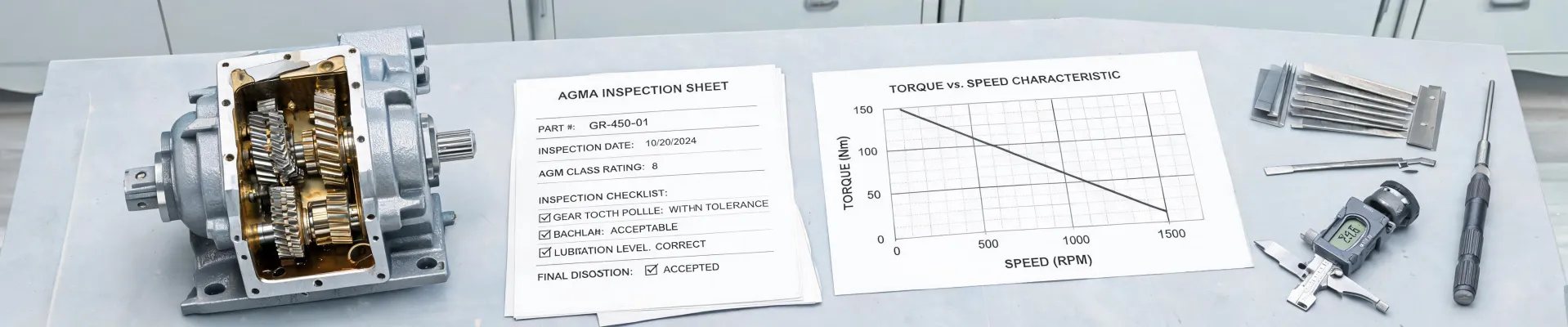
Specs are not suggestions
I think we've all been guilty of it—focusing on the big-ticket items in a motion control system. The servo motor. The gearbox. The drive. We spend hours selecting those, cross-referencing torque curves and inertia ratios. Then we grab whatever spur gear or bearing fits the bore size and call it a day.
That's a mistake.
Look, I'm the guy who reviews every component that leaves our facility. Over the past four years, that's roughly 200+ unique items annually—everything from 16DP spur gears to stainless steel ball bearings and servo motors with encoders. And I've seen one pattern repeat more often than any other: the small parts cause the big failures.
The $18,000 lesson
Here's what I mean. In Q2 of 2023, we approved a batch of what looked like standard Boston Gear spur gears—16DP, nothing exotic. The vendor's spec sheet matched ours on paper. Pitch diameter? Check. Material? Check. Face width? Check. But when we received the first delivery for a 50,000-unit annual order, something was off.
The tooth profile looked... wrong. I'm not a gear designer, but I've seen enough to know when a flank angle doesn't look right. We measured it. The pressure angle was 20.5 degrees instead of 20.0. Normal tolerance is plus or minus 0.25 degrees. They were technically within acceptable range. The vendor claimed it was 'within industry standard.'
We rejected the batch anyway.
Was I being picky? Maybe. But here's what happened next: the vendor redid the batch at their cost. But we lost two weeks of production time. That delay cost us a $22,000 redo on another project and pushed back a launch. In hindsight, I should have specified the pressure angle more clearly in the original contract. But given what I knew then—that a standard 20-degree pressure angle is standard—I assumed everyone knew what standard meant. Now every contract includes explicit pressure angle requirements down to the decimal.
Why this matters for your project
The question isn't whether a 0.5-degree difference in tooth flank matters for a single gear. It's what happens when that small difference multiplies across thousands of units. A stepper motor with encoder that's off by one count per revolution? After 1000 revolutions, that's a 1000-count error. A ball bearing with a slightly undersized inner race? Hello, vibration.
I don't have hard data on industry-wide defect rates for small components. But based on our five years of order reviews, my sense is quality issues affect about 8-12% of first deliveries where the spec wasn't aggressively verified. And about 70% of those issues are in components that cost less than $10 each. Why? Because we pay less attention to them.
The blind test
I ran a quick blind test with our design engineering team a few months ago. Same small servo motor from two different batches—one from a vendor we'd worked with for years, one from a new supplier. Both met spec on paper. I asked the engineers to rate them on 'feel'—smoothness at low RPM, vibration, audible noise. Without knowing which was which, 8 out of 10 identified the established vendor's motor as 'more professional.' The cost difference? $3.40 per unit. On a 10,000-unit run, that's $34,000 for measurably better performance and perception.
The counterargument I hear
I know what you're thinking: 'But for my application, does it really matter? A small bourdon effect on a bearing seal, a slight deviation in gear hardness—who cares?'
Maybe you're right. If you're building a one-off prototype that runs for 50 hours total, a generic spur gear might work fine. If you're specifying linear actuators for a stage setup that moves four times a year, a standard ball bearing might be sufficient. This isn't a one-size-fits-all argument—I can only speak to production runs and systems where uptime matters. Your mileage might vary if you're doing small batch, low-stakes work.
But here's the thing: I've seen too many cases where someone assumed the small part didn't matter, and it cost time, money, or reputation. I once reviewed a project that used a stepper motor without an encoder because 'it's just for positioning.' The missed position errors required a $3,000 sensor retrofit after installation. The encoder would have added $40 to the original build.
So what do I actually recommend?
If you're specifying components like Boston Gear spur gears, worm gears, ball bearings, or small servo motors—especially for anything beyond a one-off experiment—here's my advice:
- Treat every spec as non-negotiable until proven otherwise. That includes dimensions, materials, hardness, surface finish, tolerance class. If it's on the drawing, verify it.
- Ask your vendor what they consider 'standard.' One vendor's standard is another's premium. You might be paying for commercial-grade tolerances when you assumed precision-grade.
- Run a small batch test before committing to volume. I know it slows down procurement. But catching a pressure angle issue on 50 units is cheaper than catching it on 5,000.
- Total cost includes the cost of fixing a failure. A $1.50 ball bearing that fails and damages a $2,000 gearbox isn't a good deal—it's a $2,001.50 mistake.
I wish I had tracked the number of projects that ran over budget because of small-component issues. But what I can say anecdotally is that it's a recurring pattern. And the fix is usually straightforward: pay attention to the stuff that costs the least, because it's often the stuff that derails the most.
An informed customer asks better questions and makes faster decisions.
—Not a quote, just what I've learned from four years of reviewing parts.

Elena Markovic
Elena Markovic is an independent industrial motor and drive systems analyst covering induction motors, servo motors, stepper motors, and variable-frequency drives. She examines IEC 60034-30-1 efficiency classes, IEC 61800-9-2 drive-system losses, speed-torque curves, duty cycles, thermal limits, and feedback compatibility across operating envelopes. Her evidence-led guides help OEM engineers and plant teams select efficient motion packages, plan integration, and reduce commissioning risk.