-
1. What's a ball bearing, exactly?
-
2. How does a ball bearing actually work?
-
3. Why do I need a specific load rating for my ball bearing?
-
4. Why is the Boston Gear catalog important for engineers?
-
5. How do I evaluate ball bearing suppliers?
-
6. What's an impact universal joint, and when would I use one?
-
7. How do I avoid the most common spec mistake?
-
8. What's the best way to prevent issues: over-spec or verify standards?
I've been a quality and compliance manager at a gear and motion control distributor for about seven years now. I review every product batch before it reaches customers—roughly 400+ unique items per quarter. And if I'm being honest, I've rejected about 12% of first deliveries in 2024 due to spec mismatches on things like hardness, shaft tolerance, or material certs. So when someone asks me about the Boston Gear catalog, I don't just think about part numbers. I think about what actually matters when you're putting these components into a system that needs to run for years.
Below are the questions I get most often from engineers and maintenance teams. I've tried to keep the answers direct—no fluff, just what I've learned from checking thousands of parts.
1. What's a ball bearing, exactly?
Simplest definition: it's a set of steel balls sandwiched between two rings that lets things spin with less friction. But if you're sourcing them through a ball bearing suppliers list, you need to care about more than just the inner and outer diameter.
From the outside, all ball bearings look the same. The reality is that the internal clearance, the cage material (steel vs. phenolic vs. polymer), and the lubricant type determine whether that bearing lasts 500 hours or 50,000 hours in your specific application. In our Q1 2024 quality audit, we flagged a batch of 600 bearings where the lubricant viscosity was off spec by 15%. The vendor said it was 'within industry standard.' We rejected it. Now every contract includes the exact NLGI grade and base oil viscosity.
2. How does a ball bearing actually work?
The balls roll between the inner and outer raceways, converting sliding friction into rolling friction. That's the basic physics. But what engineers often miss is the load path.
People assume the balls carry all the load. What they don't see is that the load is actually transmitted through a tiny elliptical contact patch—called the Hertzian contact area. If that patch is too small (wrong ball size) or the raceway hardness is off (below HRC 58-62 typically), you get brinelling. I've seen it on a $14,000 servo motor retrofit: 8,000 units in storage developed false brinelling marks because the bearing supplier substituted a softer raceway steel without telling us. That was a $22,000 redo.
3. Why do I need a specific load rating for my ball bearing?
Because guessing costs real money. The numbers said go with a standard C3 clearance bearing—cheaper and available. My gut said push for a C4 with tighter radial play. Went with my gut. Turns out the application had intermittent thermal spikes that would have locked up a C3.
The load rating (static and dynamic) isn't just a number on a spec sheet. It's your insurance against premature failure. For a typical conveyor line running 16 hours a day, the wrong load rating can mean replacing bearings every 3 months instead of every 3 years. That's not just part cost—that's downtime, labor, and lost production.
4. Why is the Boston Gear catalog important for engineers?
Honestly, before I started in this role, I thought product catalogs were just price lists with nice photos. (Should mention: I was wrong.) The Boston Gear catalog is actually a technical reference. It includes shaft load ratings, backlash tolerances, thermal limits, and mounting configurations that you don't always get from a generic spec sheet.
Here's what I like about it: the 700 series, for example, specifies the exact gear hardness (teeth induction hardened to Rc 55-62) and the housing material (close-grain cast iron). That level of detail matters when you're cross-referencing a replacement or designing a new system. It's not just a part number in a box—it's geometry, material, and performance data in one place.
5. How do I evaluate ball bearing suppliers?
I've worked with maybe 30 different bearing sources over my career. Maybe 25—let's say two dozen. The ones I trust share three things:
- They provide material traceability. Not just 'it's 52100 steel.' I want the heat number and the mill cert.
- They accept audit visits. I've walked into warehouses that looked like they stored bearings next to a grinding wheel. Dust and bearings do not mix.
- They fail fast. The best suppliers tell you 'we can't meet that spec for that price' upfront. The worst ones say 'no problem' and then deliver something that passes visual but fails inspection.
Oh, and I should add: don't assume that big-name distributors always have better quality. I've rejected plenty of parts from major houses because the packaging was damaged or the certs were outdated.
6. What's an impact universal joint, and when would I use one?
An impact universal joint is designed to handle sudden shock loads—not just sustained torque. Think of it like a standard U-joint but with a reinforced cross and heavier bearing caps. You'd use one in applications where the load isn't smooth: impact wrenches, heavy-duty conveyors with intermittent jams, or indexing tables that start and stop rapidly.
That said, people sometimes use impact-rated joints where a standard joint would be fine, just to 'be safe.' The cost difference can be 2x to 3x. The question is: are you buying insurance against a failure mode that actually exists in your system? From a quality perspective, I'd rather see an engineered choice—matching the joint rating to the peak torque, not just guessing.
7. How do I avoid the most common spec mistake?
The mistake I see most often: oversizing without checking the system. An engineer specifies a gearbox with a 2.0 service factor because 'it's safer.' But a higher-rated gearbox has different inertia, weight, and sometimes different shaft dimensions. That 'safety margin' can cause resonance issues or require re-engineering the mounts.
A 12-point checklist I created after my third mistake on this exact issue has saved us an estimated $8,000 in potential rework. The checklist includes: verify mounting bolt pattern, check output shaft diameter vs. existing coupling, confirm thermal dissipation at expected cycle rate, and cross-reference oil type with ambient temperature range. Five minutes of verification beats five days of correction.
I should note: even after choosing Boston Gear for a recent 50,000-unit order, I kept second-guessing. What if the backlash tolerance was too tight for their assembly line? The two weeks until the first production sample arrived were stressful. But spec checked out, zero rejects on the first lot. That's when I relaxed.
8. What's the best way to prevent issues: over-spec or verify standards?
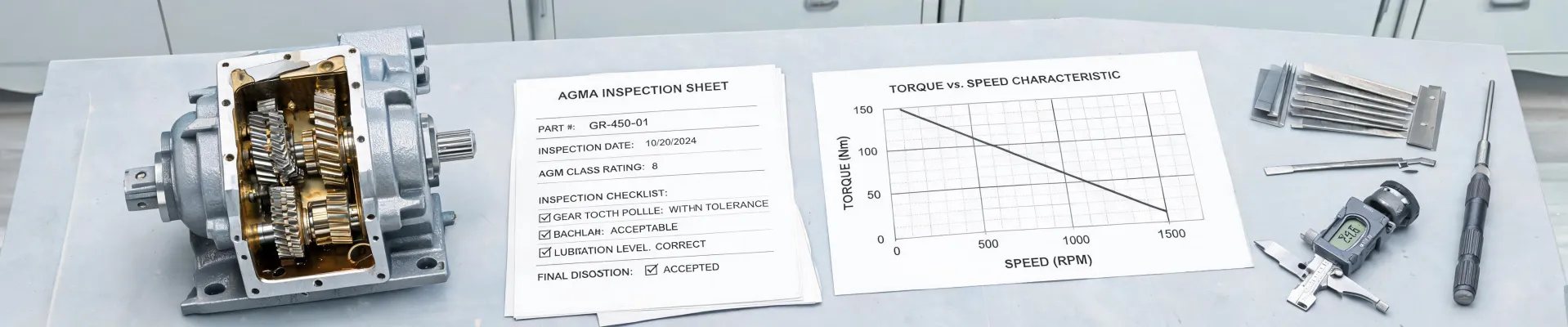
Prevention over cure, every time. Over-specifying is a gamble—you're spending money you might not need to. Verifying against a known standard (like AGMA or ISO) is the better path.
At least, that's been my experience with mid-to-high volume production. For one-off custom builds, you might over-spec a bit because rework is less painful than a field failure. But for repeat orders, invest the time in verification upfront. Build the spec, check the incoming parts, and don't let schedule pressure skip the inspection step. I've seen what happens when that pressure wins—and it's never cheaper in the long run.
Hit 'approve' on that order and immediately thought: did I miss anything? Didn't relax until the first 200 units passed every dimension check.

Elena Markovic
Elena Markovic is an independent industrial motor and drive systems analyst covering induction motors, servo motors, stepper motors, and variable-frequency drives. She examines IEC 60034-30-1 efficiency classes, IEC 61800-9-2 drive-system losses, speed-torque curves, duty cycles, thermal limits, and feedback compatibility across operating envelopes. Her evidence-led guides help OEM engineers and plant teams select efficient motion packages, plan integration, and reduce commissioning risk.